
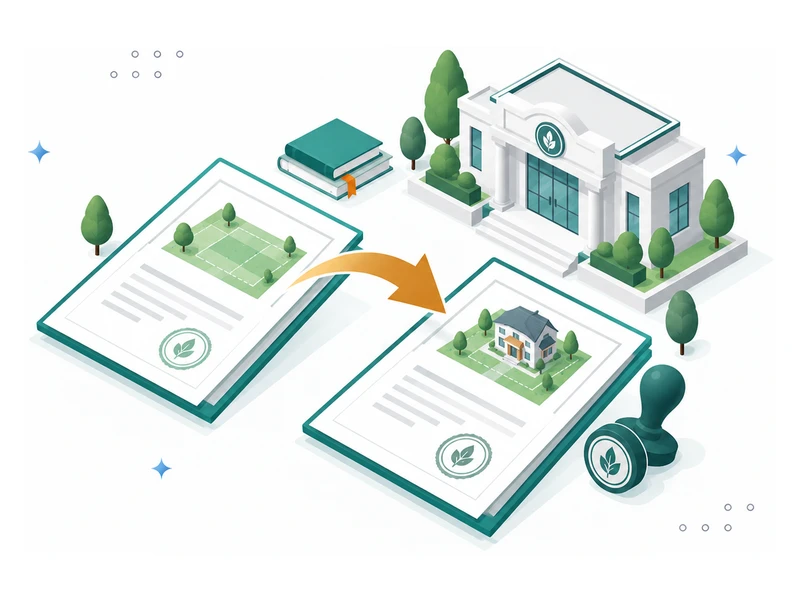
Why Tamil Nadu Needs Both SRO Registration and Revenue Records
Last updated: September 2026
✓ QUICK ANSWER
Patta Transfer in Tamil Nadu: Quick Answer
Registration of a sale deed at the Sub-Registrar Office and updating the Patta in the Revenue Department are related but separate processes.
In eligible cases, Tamil Nadu’s integrated registration and land-record systems can enable the Patta to be updated as part of the connected process after registration. However, cases involving subdivision, inheritance, joint Pattas, extent changes, or discrepancies in land records may still require additional processing through the Revenue Department.
This guide explains how the SRO and Revenue Department records work together, when Patta transfer may happen through the integrated process, and when additional action may still be required.
Table of Contents
- The Story of a Land Transaction Gone Wrong
- How We Got Here: A Colonial Inheritance
- The Two Guardians: What They Actually Do
- The Pain Points: Where Citizens Suffer
- Tamil Nadu’s Answer: Closing the Gap
- 2026 Update: What Changed in Patta Transfer?
- What Still Needs Fixing
- The Road Ahead
- Frequently Asked Questions
The Story of a Land Transaction Gone Wrong
Imagine Murugan, a schoolteacher from Madurai. After years of saving, he finally purchases a plot of land from his neighbour Rajan. They visit the Sub-Registrar Office (SRO), pay stamp duty, sign the sale deed, and walk out with a registered document in hand. Murugan is elated. He is, in his mind, the legal owner of the land. Life goes on.
Three years later, Murugan approaches his bank for a home loan to construct a house on the plot. The bank officer checks the records and delivers a shock: the patta still shows Rajan’s name. The bank refuses the loan. Murugan, confused and frustrated, realises that his registered deed at the SRO and the revenue record at the Tahsildar’s office are two entirely different worlds, and he had only taken care of one.
This is not a rare story. It plays out across Tamil Nadu thousands of times every month. The confusion stems from a structural split that is over a century old: two systems, built for two different purposes, never fully designed to speak to each other.
How We Got Here: A Colonial Inheritance
The roots of this complexity trace back to British India. The colonial administration had two distinct priorities when it came to land. The first was to create a public record of transactions: to record who sold what to whom, and to prevent fraud. This gave rise to the Registration Act of 1908, a central legislation that mandated the registration of all immovable property transactions above a nominal value. Sub-Registrar Offices were created across the country as the custodians of this transaction record.
The second priority was to collect land revenue (tax) from cultivators and track possession of land for administrative purposes. This function was managed by the State Revenue machinery: the Tahsildar, the Village Administrative Officer (VAO), and the land settlement records that eventually became the patta (and its companion, chitta). These were not designed to record transactions. They were designed to record possession and fiscal liability.
India inherited both systems at independence in 1947 and chose to retain both. For over 75 years, neither system has been formally unified into a single land title framework. The Registration Act remains central legislation. Revenue records remain a state subject. The result is a structural gap that has frustrated millions of property owners across generations.
The Two Guardians: What They Actually Do
Understanding why both systems exist requires understanding what each one is actually designed to do. They are not duplicates. They serve fundamentally different legal and administrative purposes.
| SRO (Registration) | Revenue Record (Patta) | |
|---|---|---|
| Records | The transaction: who sold what to whom | Possession and tax liability |
| Governing law | Registration Act, 1908 | State revenue law |
| What it proves | A legal transfer occurred on a specific date | Presumptive evidence of possession only, not a title deed |
| Required for | Court evidence, Encumbrance Certificate | Bank loans, government schemes, subsidies |
| In a dispute | Important evidence of the registered transaction and title chain; Patta itself does not confer title | Governs day-to-day administrative authority |
The SRO’s Role in Patta Transfer
The Sub-Registrar Office records the act of transfer. When you register a sale deed, you are creating a legally enforceable public record that a transaction occurred on a specific date between specific parties for a specific consideration. This is the document that a civil court will accept as primary evidence in a property dispute.
- Under Section 17 of the Registration Act 1908, registration of immovable property transactions is mandatory for properties above ₹100 in value
- Under Section 49 of the Registration Act 1908, a document that legally requires registration cannot be used as evidence of the transaction or title it relates to unless it is registered
- Registration creates a public, time-stamped record of the transaction. This is important evidence when resolving a dispute between competing buyers, though the outcome still depends on the validity of each transaction, not registration date alone
- Registration creates a public notice effect; the Encumbrance Certificate (EC) reflects registered transactions for the period you search. It does not cover unregistered agreements, oral arrangements, or claims outside the registration system
The Revenue Record: Guardian of Possession
The Revenue Department’s patta is a fiscal and administrative record. It records who is liable to pay land tax, who is in possession, and in the case of agricultural land, what is being cultivated. It is not a title deed. The Supreme Court of India has repeatedly held that patta is only presumptive evidence of possession, not conclusive proof of ownership.
- Patta is essential for bank loans; most lenders require it before approving a mortgage
- Required for access to government agricultural schemes, subsidies, and compensation in land acquisition
- Used in court as corroborating evidence of possession, alongside a registered deed
- Determines who receives notices from local bodies, revenue authorities, and government agencies
- A registered deed generally carries stronger evidentiary weight than a patta in a civil title dispute because patta does not itself confer title. Day-to-day administrative power, however, still rests with Revenue
The Pain Points: Where Citizens Suffer
The gap between these two systems is not merely academic. It creates real, tangible hardship for ordinary citizens who must navigate two separate bureaucracies, often with little guidance and significant risk of exploitation.
The Burden of Dual Visits
After registering at the SRO, a buyer historically had to separately approach the Tahsildar’s office to apply for a mutation: the update of revenue records to reflect the new owner. This meant:
- A separate application with a fresh set of documents
- A fee of ₹60 to ₹100 per application at CSCs or Tahsildar offices
- Multiple follow-up visits, often over weeks or months
- Heavy dependence on middlemen and agents who charged unofficial fees to navigate the process
The Scale of the Backlog
The sheer volume of pending mutations across Tamil Nadu reveals just how broken the old system was:
- Monthly patta applications received by Revenue Dept: approximately 3,00,000 (3 lakh)
- Applications pending statewide (as of mid-2024): approximately 2,00,000 (2 lakh)
- Monthly registrations at SROs across Tamil Nadu: approximately 85,000 documents
- Primary cause of delays: shortage of surveyors and revenue staff
Real-World Consequences
The downstream impact of delayed mutation goes far beyond inconvenience:
- Bank loan rejections despite holding a valid registered sale deed, because patta still shows the previous owner
- Legal disputes when the registered deed and patta show different owners, creating grounds for fraudulent claims
- Heirs unable to access government schemes, subsidies, or compensation because revenue records were never updated after a parent’s death
- Builders and layout developers holding unsold plots that appear in revenue records under old names, creating title chain complications
- Corruption opportunities in the gap: middlemen exploiting the confusion between two departments that historically did not communicate
Tamil Nadu’s Answer: Closing the Gap
Tamil Nadu’s response to this decades-old problem has been a determined push toward digital integration: connecting the SRO’s TNREGINET portal with the Revenue Department’s eServices platform, so that a registration at the Sub-Registrar Office automatically triggers a patta mutation without any separate application from the citizen.
The Journey to Integration
The initiative was not born overnight. The automatic land transfer programme was first launched approximately three years before 2024, but in its early form it still required Revenue authority approval, which meant delays of several days. The technology existed, but the administrative handshake between the two departments was incomplete.
The breakthrough came in June 2024, when the Tamil Nadu government announced that the TNREGINET (Registration) and Tamil Nilam/eServices (Revenue) portals were fully integrated statewide. For eligible transactions, the patta now updates instantaneously at the moment of registration. No separate visit to the Tahsildar is required.
Before: the old process
→↓
→↓
→↓
→↓
After: since the June 2024 integration (eligible transactions)
→↓
→↓
How the Automatic Transfer Works
- Buyer and seller complete registration at the SRO as normal
- The TNREGINET system sends the registration data directly to the Revenue portal
- Patta is updated in real-time in the new owner’s name
- New owner can download the updated patta from eservices.tn.gov.in within minutes of registration
- The updated patta includes a QR code for digital verification, legally valid without physical attestation
- The new owner’s name also appears instantly on the Encumbrance Certificate on TNREGINET
The Numbers Behind the Reform
- Monthly SRO registrations statewide: ~85,000 documents
- Registrations not requiring subdivision (auto-eligible, June 2024): ~33,000 of ~85,000 monthly registrations, or roughly 40% at that time. Eligibility has since widened (see the 2026 Update below)
- Conditions for automatic transfer: Seller must hold individual patta; no subdivision; no change in land extent
- Primary beneficiaries: Apartment buyers, individual house purchasers, plot buyers in approved layouts
- Patta format upgrade: QR code embedded; legally valid without attestation
2026 Update: What Changed in Patta Transfer?
Two developments since this guide was first written are worth knowing about if you’re navigating a transaction today.
Integrated Land Record and Patta Transfer History
On 4 March 2026, Tamil Nadu’s Revenue Department launched two new services on the e-Services portal, built by the National Informatics Centre. The Integrated Land Record (ILR) combines the Record of Rights, the FMB survey map, and the Chitta into a single digitised reference document for a property. The Patta Transfer History service lets you look up the details and history of Patta transfers carried out online from 2016 onwards, for private lands, for a specific survey number.
For a buyer, this matters because it makes it much easier to spot a red flag before you commit: if a seller’s story about a property’s ownership history doesn’t match what the Patta Transfer History shows, that’s worth investigating before you register anything. Neither service replaces the due diligence described earlier in this guide. The ILR is a convenience layer over the underlying records, not a substitute for checking the registered sale deed and title chain. The Patta Transfer History service covers online Patta transfers from 2016 onwards for private lands and should not be read as a complete history of all earlier or offline transfers.
Automatic Transfer Now Covers More Co-Signed and POA Transactions
Under a government order dated 25 June 2026, followed by a Ministerial press statement on 3 July 2026, Revenue Minister K.A. Sengottaiyan announced that the automatic patta-transfer system, previously limited to straightforward single-owner sales, has been expanded. Automatic mutation now also proceeds for sales involving qualifying family co-signatories, where the seller’s spouse, son, or daughter co-signs the sale deed alongside the landowner, and for sales where a registered, valid Power of Attorney holder executes the deed on the seller’s behalf, even if the POA holder’s name doesn’t exactly match existing records. The patta-numbering workflow was also revised: previously, if a buyer already held a patta in the same village, an official had to manually locate that existing patta and append the newly purchased survey number to it; the system can now instead assign the next available patta number in the village automatically, regardless of whether the buyer already holds one there. These were approved reforms that the government directed to be incorporated into the automated Patta-transfer software within 15 days of the revised order.
This widens the pool of transactions eligible for automatic transfer beyond the ~40% figure discussed earlier in this guide. Sales involving qualifying family co-signatories and POA-executed sales that previously required manual mutation may now qualify. Pinewood has not seen a revised official percentage, so treat “~40%” elsewhere in this guide as the June 2024 baseline, not the current eligible share.
These are approved, directed reforms, not guarantees for every case. Verification, survey accuracy, and the specific documents involved still determine the outcome for any individual transaction.
What Still Needs Fixing
The June 2024 integration is a significant achievement, but it covers only the cleaner, simpler transactions.
| ~40%of monthly registrations in June 2024: automatic, patta updates in minutes | ~60%of monthly registrations in June 2024: needed manual mutation, could take weeks |
This was the June 2024 split when the integration launched. Automatic-transfer eligibility has since widened (see the 2026 Update above), and Pinewood has not seen a revised official percentage.
The categories that remain in the old system include:
- Subdivisions: where a survey number is being split between buyers, requiring a surveyor’s involvement and cannot be automated
- Properties where the seller does not have an individual patta (joint/undivided family properties, ancestral land)
- Inheritance and legal heir cases, where death of an owner triggers succession
- Gift deed transfers: unclear coverage under the current automatic system
- Properties with court orders or encumbrances that restrict automated updates
Additionally, an estimated 2 lakh patta applications were pending statewide as of mid-2024, before the integration launched. Pinewood has not found a current, verified figure for how much of that backlog remains; revenue staff vacancies, while being addressed, have historically been the primary bottleneck in clearing it.
The Road Ahead
Tamil Nadu’s integration journey points toward a larger ambition: a unified land title system where a single registered transaction is the complete and final record, with no separate revenue mutation, no dual-department chase, and no middleman opportunity. States like Telangana (through its Dharani/Bhu Bharati portal) and Andhra Pradesh (through Bhudhaar) are pursuing similar visions, each grappling with the same colonial-era structural split.
Tamil Nadu has taken a significant leap with the rollout of STAR 3.0 (Simplified and Transparent Administration of Registration) across all 575 Sub-Registrar Offices statewide. Two nodal officers have been appointed to monitor implementation and resolve issues across the full network. STAR 3.0 introduces paperless registration for all 30 deed types: citizens are no longer required to carry physical documents to SROs. More significantly, the department has enabled presenceless (fully online) registration for 10 deed categories, including sale deeds for new apartments and plots, allowing the entire registration process to be completed without visiting the Sub-Registrar Office at all.
The next frontier remains extending automatic patta mutation to subdivision cases through smarter surveyor integration, covering inheritance and gift deed transfers, and clearing the historical backlog of pending applications.
Murugan’s story may soon have a different ending. The day when a buyer walks out of the SRO and simultaneously becomes the recorded owner in both the registration and revenue systems, without a second visit, a second form, or a second fee, is no longer a distant dream for Tamil Nadu. It is an unfinished project, already halfway built.
Is Your Patta Still in the Previous Owner’s Name?
A completed property registration does not always mean that every revenue record is already in order.
If your Patta has not been transferred, the property requires subdivision, or the ownership or survey details in the revenue records do not match your documents, Pinewood Property Consultants can help you understand the issue and coordinate the required process.
- Patta name transfer
- Subdivision Patta
- Patta / Chitta / FMB-related record issues
- Ownership or survey-detail discrepancies
- Document review before submission
- Coordination with the relevant authorities
Frequently Asked Questions
What is the SRO’s role in patta transfer?
The Sub-Registrar Office (SRO) records the registered sale deed, which documents the legal transaction. It does not update the patta itself; that is the Revenue Department’s job. Since June 2024, Tamil Nadu’s TNREGINET and Revenue eServices portals are integrated, so for eligible transactions the SRO’s registration data is sent directly to the Revenue portal and the patta updates automatically, without a separate visit to the Tahsildar.
How many days does patta transfer take?
For eligible transactions (where the seller holds an individual patta, there is no subdivision, and no change in land extent), the patta now updates within minutes of registration. As of June 2024, roughly 60% of transactions fell outside this automatic scope (subdivisions, joint or ancestral property, inheritance cases, gift deeds, or properties with court orders); a June 2026 expansion has since brought some sales with qualifying family co-signatories, and sales executed by Power of Attorney, into the automatic system (see the 2026 Update section). For transactions that still require manual mutation, the traditional process can take several weeks, depending on surveyor and revenue staff availability.
Does patta transfer automatically after every registration in Tamil Nadu?
No. As of the June 2024 integration, only about 40% of monthly registrations met the automatic-transfer conditions: an individual (not joint) patta held by the seller, no subdivision involved, and no change in land extent. A June 2026 expansion widened this to also cover sales co-signed by the seller’s spouse, son, or daughter, and sales executed by a valid Power of Attorney holder. Subdivisions, inheritance, gift deeds, and properties with encumbrances still require the manual process.
What do I do if my patta wasn’t updated after registration?
First confirm whether your transaction was eligible for automatic transfer (see above). If it was eligible but the patta still hasn’t updated, or if it falls into one of the manual categories, you’ll need to file (or follow up on) a mutation application with the Tahsildar’s office. Pinewood can check the status and handle this follow-up on your behalf.
Sources & Official References
- Tamil Nadu e-Services Portal / TNREGINET: official registration and revenue-record portal
- National Informatics Centre (NIC), Tamil Nadu: Integrated Land Record and Patta Transfer History launch, 4 March 2026
- Registration Act, 1908 (Section 17, Section 49)
- Vadiyala Prabhakar Rao & Ors. v. The Government of Andhra Pradesh & Ors., 2026 LiveLaw (SC) 469 (Supreme Court, 6 May 2026), as reported by LiveLaw
- G.O.(Ms.) No. 526, Revenue and Disaster Management Department, dated 25.06.2026, and the associated Tamil Nadu Government/DIPR press material dated 3 July 2026, referenced by number and date; the primary document itself was not located or read in this research pass
- New Indian Express, June 2024: original TNREGINET/Revenue integration reporting
- Secondary reporting corroborating the 25 June/3 July 2026 changes: dtnext.in and Asianet News Tamil, each fetched and read directly