
For Landowners in Chennai & Tamil Nadu
Know what your land records say before you divide, transfer, develop or sell.
Land records, survey and documentation support for landowners in Chennai & Tamil Nadu.
Land is defined by its title, revenue records, survey records, physical boundaries and family rights. We help you understand, regularise and protect your land with the right documentation and end-to-end coordination.
- Patta & Chitta
- FMB & survey
- Legal heirs
- Deeds & registration
- Sub-division
- Encroachment
Why Land Issues Surface Late
Land can look simple, but the issues often appear when plans move forward.
Many owners find a gap in their records only when they try to divide, transfer, mortgage, sell or develop. We work with landowners across Chennai, the Kancheepuram, Tiruvallur and Chengalpattu districts and the rest of Tamil Nadu.

Records don't match
The sale deed, Patta, survey and FMB records may each show different details.

Boundaries can differ
The extent in the records and the boundary on the ground may not be the same.

Ownership changes over time
Inherited or jointly owned land can end up with several people holding a stake.

Issues surface late
Often only when you try to sell, mortgage, divide or develop the land.
Our Approach
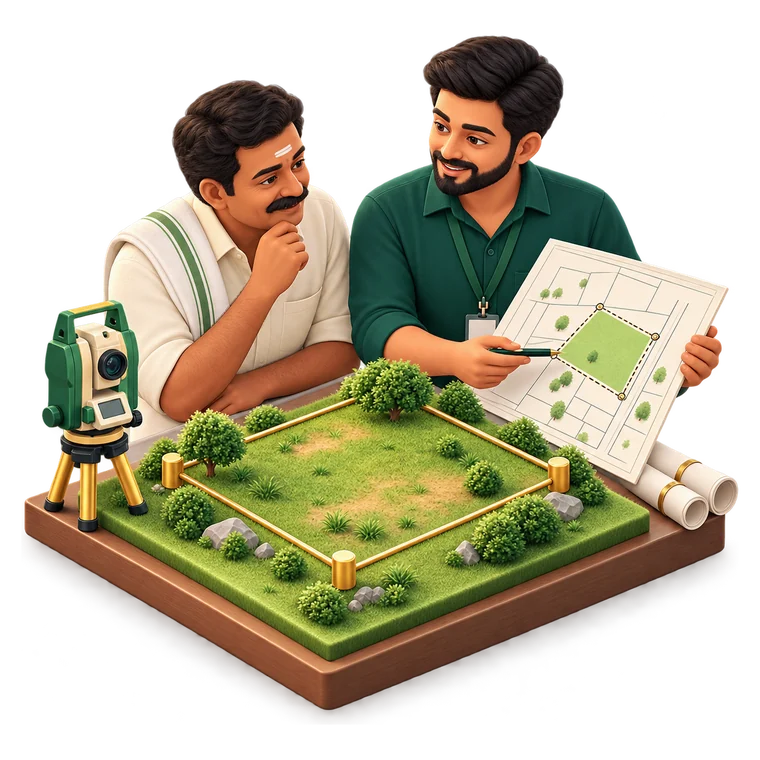
We look at the complete picture, not just one document.
Title, revenue records, survey records, the physical boundary and family rights are separate systems, and each can tell a different story about the same land. We review them together to help you take the right next step.

Ownership & Title
Review deeds, earlier transactions and the chain of title.

Revenue Records
Patta, Chitta and Adangal, and how the land is classified.

Survey / FMB
Survey number, extent, FMB sketch and sub-division details.
Physical Boundary
Compare the situation on the ground with the records and check for encroachment.
Family / Co-owner Rights
Identify legal heirs, co-owners and the consents required.

Registered Documents
Check and prepare the deeds needed for your objective.
Common Landowner Situations
Real situations we help landowners with
If one of these sounds familiar, the first step is usually to understand exactly which record or document is out of line.
Patta still in an earlier owner's name
The revenue records show someone else as holder, which can hold up a sale, mortgage or approval.
Survey / extent / FMB mismatch
The deed, the FMB and the land on the ground give different extents, which can stall a division or sale.
Encroachment, boundary or access issue
Someone else is using part of the land, the boundary is unclear, or access is disputed.

Inherited or shared land
Heirs or co-owners hold the land, but the records may not show it.

Error in a registered document
A name, survey number or extent in the deed is wrong.
Subdivision or regularisation needed
One Patta covers land to be divided or partly sold, or the plot sits in a layout that was never approved.
Our Landowner Journey
A step-by-step process to a clear and secure land position
Six stages, in an order that avoids redoing work: understand what the records say, settle the boundary and the owners, then correct and regularise.
Understand Records
Read the deed, revenue records and survey records side by side, so you know what each one shows.
- Deed & parent documents
- Patta / Chitta / Adangal
- Encumbrance certificate
Establish Boundaries
Compare the records with the land on the ground, so the extent and boundary are clear.
- FMB & survey extent
- Physical boundary check
- Encroachment & access review
Align Ownership / Heirs
Identify every owner and legal heir, so it is clear who needs to take part.
- Legal-heir position
- Consents mapped
- Family arrangements recorded
Correct Documents
Choose the right instrument and register it, so the documents match the facts.
- Right instrument identified
- Drafting & consents
- Registration coordinated
Subdivide / Regularise
Update the revenue records where required, so each portion has its own record.
- Patta sub-division
- Survey & FMB update
- Regularisation, where eligible

Ready for Next Step
Hold, transfer, sell or develop from a clearer position.
- Records aligned
- Documents in order
- Options laid out
How We Work
We coordinate the process, the paperwork and the professionals.
We work alongside advocates, surveyors and the relevant authorities. We do not replace them; we help you reach them with the right documents, in the right order.
When Family Ownership Is Involved
Shared land needs clear rights before it needs a transaction.
Inherited or jointly held land often has several people with a stake in it, sometimes living in different places. We help families understand their rights, look at practical options such as partition or settlement, and coordinate the documentation, sensitively and factually. Where there is a dispute, or a Will is involved, an advocate's advice comes first.

Multiple co-owners
Coordinate decisions and documents across everyone who holds an undivided share.
Inherited land
Understand what has and has not been transferred since the original owner.
Legal heirs
Identify the heirs and the documents that support their position.
Consent & signing
Plan how every required signatory can take part, including anyone living elsewhere.
Right Document For The Issue
Choose the right document for your situation.
The right instrument depends on what has to change and who is involved. We help you understand which one applies, then prepare it and coordinate its registration or application.
Rectification Deed
What it doesCorrects an error in an earlier registered document, such as a wrong name, survey number, extent or schedule.
Often relevant whenThe mistake is in the document itself and the parties agree to correct it. Some errors are corrected through the authorities instead, so the route depends on the mistake.
Ratification Deed
What it doesConfirms an act on the property, such as a sale or lease, that was carried out without proper authority.
Often relevant whenThe rightful owner wishes to accept it. Whether ratification is available and enough depends on the facts, so an advocate's view comes first.
Settlement Deed
What it doesTransfers land within a family by way of settlement. Unlike a Will, it can take effect during the owner's lifetime, depending on its terms.
Often relevant whenAn owner wants to provide for relatives now. A gift or release deed may fit better, depending on the relationship, any consideration and existing rights.
Partition Deed
What it doesDivides jointly held land into separate shares among the co-owners.
Often relevant whenCo-owners, often family members, agree how to divide it. It usually needs every co-owner's participation, and separate Pattas follow through sub-division.
Declaration Deed
What it doesPlaces a fact about the property on record, such as who the legal heirs are.
Often relevant whenA statement needs to be recorded to support other documents. It does not by itself create or prove title.
Patta Sub-division
What it doesSplits one Patta into separate Pattas, each with its own survey and FMB sketch.
Often relevant whenLand is being divided or partly sold. It involves a survey and an application to the revenue authorities, and timelines are set by the department.
Our role is to coordinate the process. An advocate advises on which document suits your facts, and decisions on records rest with the authorities. Stamp duty and registration charges are those set by the Registration Department.
Across Authorities
One issue can involve several departments and specialists.
The route depends on what the records show and who is involved. Because documentation and approvals for one property can sit with different offices, we work out who is involved, prepare what each needs and follow up.
- Registration DepartmentDeeds and their registration at the Sub-Registrar's office.
- Revenue / Taluk OfficePatta, Chitta and other revenue-record updates.
- Survey DepartmentFMB, measurement and sub-division survey.
- Advocates / specialistsLegal opinion and drafting where the facts need it.
Depending on the issue, some or all of these are involved, and the order can vary.
Looking for something specific?
Explore all property services
Land matters often overlap with surveys, revenue records, deeds, approvals and development.
Once The Land Position Is Clear
A clear land position gives you more options.
Every owner's plan is different. Holding, dividing, transferring within the family, selling, mortgaging or developing are all possible next steps, and none of them is the default.

Hold & protect
Keep the records current so the land stays easy to deal with.

Transfer within family
Plan a settlement, gift, partition or release on clear records.

Sell
Go to market with documents a buyer's advocate can verify. See our support for sellers.

Mortgage / loan
Present a clearer file to a bank when you need finance.

Develop / joint venture
Check development readiness, including approvals, before a development or joint-venture discussion. See our Promoters page.

Landowner Scenario
What a clear land review can look like
Consider a landowner, we will call him Karthik. His grandfather bought a plot near Chengalpattu many years ago. The grandfather has passed away, and Karthik and his parents now want to know where the family stands before they divide the land or use it to raise a loan. When the file is reviewed:
- Sale deed: in the grandfather's name, with a clear ownership trail
- Patta: still in the grandfather's name
- FMB / survey: the extent differs slightly from the deed
- Family: the grandfather's legal heirs need to be identified before anything is settled or divided
- Pinewood's role: help the family work out the sequence, for example legal-heir documentation, a Patta update, a survey check and then the right deed, and coordinate the advocate, surveyor and authorities involved
With the records, the boundary and the heirs understood, the family knows what needs correcting, in what order and by whom, before a bank, a buyer or an approving authority asks.
Land decisions go smoother when the records, the boundary and the family are all clear.
Frequently Asked Questions
Common questions from landowners in Chennai and Tamil Nadu about records, Patta, sub-division and deeds.
What records should I check before dividing, transferring, developing or selling land?
Start with the registered title documents and the parent documents behind them, the current Patta and Chitta, the FMB sketch and survey number, and an up-to-date encumbrance certificate. Then compare them with the extent and boundary on the ground and with who the legal heirs or co-owners are. Where they disagree, the sequence matters: settle what the records and boundary show first, then ownership, then the documents, and only then any sub-division. See our guide to revenue records in Tamil Nadu.
What if the Patta, FMB and physical measurements do not match?
It depends on where the difference is. Some mismatches in the owner's name, survey number or extent can be corrected by applying to the Revenue or Survey authorities with the registered deed, the FMB and, where needed, a licensed surveyor's report. Others need a registered document such as a rectification deed, and some need an advocate's view first. We first identify which record is out of line and which route fits.
What is an FMB and why does it matter to a landowner?
The FMB (Field Measurement Book) sketch is the Survey Department's scaled drawing of a survey field or sub-division, showing its shape, dimensions and boundaries. It matters because it is the survey record of your land's extent and boundaries, so the deed, the Patta and the ground are checked against it, especially before sub-division or a sale. See our guide to survey numbers and land records.
Does a Patta in my name prove that I own the land?
Not by itself. The Patta is a revenue record, used mainly to show who is recorded as holding the land and paying tax on it. Ownership rests on the registered title documents and how the land came to you. That is why we review the deed, Patta, Chitta, FMB and the physical boundary together.
How is the Patta updated after I buy or inherit land?
The Patta usually has to be brought into the new owner's or the legal heirs' names. Depending on the case, this may be triggered as part of registration or need a separate application through the Taluk office or the Tamil Nadu e-services portal. Commonly needed are the registered document or legal-heir proof, the earlier Patta, an encumbrance certificate and identity proof, though requirements vary. Inheritance does not by itself update the revenue records, and until the Patta reflects the heirs, a buyer, bank or approving authority will commonly ask for it. See our guide to Patta transfer in Tamil Nadu.
Can jointly owned or inherited land be divided, and who needs to take part?
In many cases, yes: co-owners or legal heirs can divide land by agreement through a partition deed, and separate Pattas follow through sub-division. Generally, everyone whose share is affected takes part or consents, and sometimes others such as a Power of Attorney holder. Where heirs disagree, or a Will or an earlier family arrangement is involved, an advocate should advise, and in some cases a court may have to decide. We help plan the documentation and the signing, including for family members living elsewhere. See joint Patta vs individual Patta.
What is the difference between partition, settlement, gift and release deeds?
A partition deed divides jointly owned property among the co-owners. A settlement deed transfers property, usually within a family, on the terms set out in the deed. A gift deed transfers property voluntarily and without payment. A release or relinquishment deed is one co-owner giving up a share in favour of another. Which applies depends on the relationship, the terms, any consideration and the existing rights, and the wrong choice can create problems later, so confirm with an advocate before signing.
What is sub-division, and can I sell or transfer only part of a larger parcel?
Sub-division splits a Patta covering a larger parcel into separate Pattas, based on a survey and an FMB sketch for each portion. Part of a parcel can generally be sold or transferred, subject to the applicable rules, but the portion has to be identified clearly in the documents, usually with a survey, and the revenue records then need sub-dividing so the new owner can hold a separate Patta. Whether other approvals apply depends on the land and its intended use. The process and timelines are set by the department; we coordinate the survey, the application and the follow-up.
My plot is in an unapproved layout. Can it be regularised?
Possibly. Tamil Nadu has a regularisation scheme (the Regularisation of Unapproved Layouts and Plots Rules, 2017, as amended) for plots whose registered sale deed is dated on or before 20 October 2016; an agreement for sale or Power of Attorney does not count as proof. Some land is excluded, such as water bodies, poromboke land and open-space reservations, and the plot needs road access. The application is made online, for an individual plot to the local body once the layout framework is approved, and for a layout to CMDA or the planning authority. As at October 2026, eligible individual plot owners can apply without a deadline, and the Government has extended the window for layouts to 30 June 2027 by Government Order. Charges are fixed per square metre by the type of local body and the authority's demand notice is final, so confirm the current position before applying. The authority decides, not Pinewood; we help check eligibility, assemble the records and coordinate with your advocate and surveyor.
What can I do about an encroachment on my land?
A common first step is a fresh survey to establish the boundary against the FMB and the registered documents, followed by marking the boundary on the ground. What comes next depends on the facts and the response, and may include a legal notice, a complaint to the authorities or civil proceedings. An advocate advises on the route. We help arrange the survey, gather the records and coordinate with the advocate.
What can I do if my land has an access or right-of-way problem?
It depends on the records and the facts: whether the survey sketches, the layout or the deeds show a road or pathway, whether a right of way was granted in a document, and how the land has actually been used. We can help you check what the records show, arrange a survey and gather documents. Establishing or enforcing a right of way is a legal question, so an advocate advises on the route.
What should I clarify before considering development or a joint-development arrangement?
It helps to have a clear title and legal-heir position, records and FMB that agree, a confirmed boundary and access, and an understanding of which approvals the intended use needs from the relevant authority, for example CMDA, DTCP or the local body. Development is one option among several, so it is worth deciding first whether you want to develop, sell or hold. An advocate should review any joint-development agreement before you sign.
Do you replace my advocate or deal with the authorities for me?
No. Pinewood coordinates the process: we review your records, work out the sequence, prepare and follow up applications, and bring in advocates and surveyors where the facts need them. Legal opinions come from advocates, and decisions on records rest with the Registration, Revenue and Survey authorities. Where an authority or advocate has to act, we work alongside them.
Not sure which service you need? View all property services
Not sure what your land records say? Let's review them together.
Tell us about the land, who owns it and what you are planning. We can help identify what to check first.
- Local expertise in Chennai & Tamil Nadu
- Records, survey and family rights reviewed together
- Coordination with advocates, surveyors and authorities
- Clear guidance on the right next step
Prefer to send the details instead? Complete the form ↓
Send Us Your Details
Your information is kept private and used only to respond to your enquiry.